Opinion · November 18, 2026
Not now, and not for laptops. Here is a bond plan I could support.
On November 17 the District's bond committee recommended a three year, $412.6 million package, down from a $1.03 billion project list. That is real progress, and close to the $400 million the District's own estimate says today's 27¢ debt rate can support. But I still cannot support a May 2027 vote. Here is what I believe a responsible bond looks like.
- Wait for the Legislature. The Texas Legislature meets in January 2027 for 140 days and will decide how much the state gives school districts. The board is set to decide in February whether to call a May election, before anyone knows those numbers. The earliest sensible bond election is November 2027.
- Earn back voters' trust first. The 2024 bond and the 2024 tax increase both failed. The District owes voters a better plan, not a faster one, starting with an independent review of how the 2018 bond money was spent.
- Cap the bond at about $400 million, sized so the debt tax rate stays at 27¢ even if growth slows. The final size should be tested in the District's financial advisor's model, not just the committee spreadsheet.
- No bonds for short life items. The District plans to repay technology over 5 years, matching its useful life. That is better than a 30 year loan, but it still means paying interest on a routine, recurring cost and coming back to voters every few years to replace it. Buses are repaid over 10 years, though the District depreciates them over 7. The committee's package still includes $97.6 million for technology ($57.0M), buses ($23.1M), and fine arts and athletics equipment ($17.5M), plus $19.2 million for the "30 Year Refresh." Those belong in the regular budget.
- Publish a project list for every school before the board votes. Every family should be able to see exactly what its school gets and what it costs.
What the District's own model shows
The committee's slide shows the debt tax rate only through FY2031, when it reaches 27.42¢. The same model shows the rate keeps climbing after that.
| Package | Size | Peak rate, District growth assumption | Peak rate, if the tax base stops growing |
|---|---|---|---|
| Full project list, 5 years (Nov 10) | $1,026.9M | 36.06¢ (+$447/yr) | 39.81¢ (+$632/yr) |
| Committee recommendation, 3 years (Nov 17) | $412.6M | 29.92¢ (+$144/yr) | 33.04¢ (+$298/yr) |
| Same package, buildings only (no technology, buses or equipment) | $315.0M | 27.00¢ ($0) | 31.20¢ (+$207/yr) |
Results from the District's 2027 Bond Planning Model (posted November 10, 2026) with the committee's November 17 selections entered and all District assumptions kept, including a 5% interest rate and debt matched to asset life. The model reproduces the committee slide exactly: $412.6M, and 27.42¢ in FY2031. Every peak shown falls in FY2033. Dollar changes are per year on a $492,982 taxable home, the model's own figure. "District growth assumption" is the model's default, tax base growth of 2.5% in FY2027 tapering to 1.5% in FY2031. "If the tax base stops growing" is the model's own "Steady" setting, 0% growth. Committee slide deck, November 17 (also posted on the committee's LiveBinder, Meeting 5). District announcement, November 18.
Correction, November 18: an earlier version of this page described the committee's package as $1.03 billion and modeled lifecycle replacements only. The committee's November 17 recommendation is $412.6 million, and the table now uses it. It also said technology would be borrowed over 20 to 30 years; the District's model repays computer equipment over 5 years.
To be straight with you: even a buildings only bond is not free. With no new bond, the District's model shows the needed debt tax rate falling to about 24.5¢ by 2030. Any bond means that drop does not happen. That is a real cost, and voters should weigh it with open eyes.
A bond should fix buildings, not pay interest on routine replacements. Wait for the state, take the $97.6 million in short life items out, test it against slower growth, and show every school's list first.
Stephen Jordan
Frisco, Texas. This is my personal opinion.
Before the 2027 bond vote
Frisco ISD's old bonds start paying off in 2034. A new bond can keep your tax rate from ever coming down.
Every number on this site comes from the District's own budgets and bond filings. Read them, check them, and ask the District to show its math.
Annual debt service in millions of dollars. Source: Frisco ISD Series 2026 Official Statement, Appendix A.
This is our money, and these are our kids.
- The District already had the funds to cover last year's budget.
- They asked us for more anyway.
- The year still closed in a surplus.
- We are not against our schools. We are against being asked to trust numbers we were never allowed to see. Look at them for yourself, add your name, and help us hold the line.
The 2027 bond, by the District's own numbers
On November 10, 2026, Frisco ISD posted its own bond planning model for the committee. The full list of projects totals $1.03 billion, and at that size the District's own assumptions raise the debt tax rate for the first time since 2018.
Update, November 18, 2026: the District announced the committee's recommendation, a three year, $412.6 million package approved by 91% of the 83 members present. The committee votes again on January 19, 2027, after a survey of community voters and Board feedback, and the Board receives it in February. District announcement. The announcement gives no tax rate projection. See what the District's own model shows for it.
Update, November 11, 2026: the District now says it "does not intend to bring a $1 billion bond package to voters." That is the right call. The test is the final number. Today's 27 cent rate supports about $400 million, by the District's own estimate.
Five years of projects, the full list
Facilities, technology, buses, program equipment and a new cosmetology program, 2027-28 through 2031-32.
Debt rate at its peak, in FY2033
An increase of 9.06 cents, from the District's own model.
A year, on the median Frisco ISD home
$492,982 taxable value, the District's figure. That is $37.22 a month at the peak.
The full ten year plan
Facilities alone schedule another $621 million for 2032-33 through 2036-37. The District's model covers only the first five years.
| What is in the five years | Amount |
|---|---|
| Facilities: lifecycle replacements and 30 year renovations | $827.5M |
| Technology | $111.9M |
| Transportation (243 buses plus support vehicles) | $52.6M |
| Fine arts equipment | $24.3M |
| Athletics equipment | $6.2M |
| Cosmetology, a new career program | $4.5M |
| Total | $1,026.9M |
How the model keeps the number that low
- It moves TIRZ money into debt payments: $5.4 million to $6.7 million a year through 2052. Today that money helps run the schools.
- It holds state aid at $13.9 million a year through 2057. That aid, the state's homestead exemption aid, is figured only on debt outstanding on August 31, 2025. New bonds earn none of it, and it shrinks as old bonds are paid off.
- It spends $32.2 million of the debt fund's reserves through the peak year.
- It repays some purchases over longer than they last. Buses are repaid over 10 years against a 7 year depreciation life, and building improvements over 30 years against 20. In its written answers to the committee, the District said it schedules repayment "to match the expected useful life" of what it buys.
- It assumes taxable values grow 2.5% next year, stepping down to 1.5%. The District's own budget shows this year's growth at 1.6%.
- It calls itself a staff estimate, "not a debt-advisor forecast."
Even with its assumptions leaning its way, the District's own model shows a tax increase. And it covers only half the plan.
How much actually fits at 27 cents
The District now says it plainly. Its November 10 committee presentation states: "The current debt 27¢ rate can support ~$400M in new debt, given today's assumptions." The same slide puts the cost of each added penny at $49.29 a year for the average homeowner.
We checked that against the District's own spreadsheet. Our rebuild of its rate calculation reproduces the District's 36.06 cent peak exactly. Then we shrank the package, keeping the District's mix of projects and timing, until the rate held at 27 cents.
| Assumptions | Largest bond at 27¢ |
|---|---|
| The District's own estimate, Meeting 4 presentation | About $400M |
| Our rerun of the District's model, including TIRZ money moved into debt payments | About $440M |
| Our rerun, with TIRZ money kept in the classroom budget | About $310M |
| The five year proposal | $1,026.9M |
The $400 million is the District's figure. The other two are our calculations from the District's posted model. A package weighted toward 30 year building work would fit somewhat more; one heavier on technology and buses would fit less.
By the District's own math, the five year proposal is more than twice what today's tax rate can carry, and more than three times if TIRZ money stays with students.
The District's own poll
The same presentation shared the District's October 2026 community survey, taken after respondents heard about facility needs and possible tax impact.
| Bond size tested | Cost to homeowner | Would support |
|---|---|---|
| $400 million | No rate increase | 65% |
| $600 million | About $11 a month | 54.5% |
| $800 million | About $20 a month | 43.7% |
| $1.03 billion, the full project list | About $37 a month at peak | Not shown |
Survey margin of error 4.4%, as reported by the District. The $37 a month is the District's own model for the five year proposal.
Support drops below half before the bond reaches $1 billion. The one size most residents support is the one the District says fits today's rate: $400 million.
"Not immediately" is not "no increase"
The District's November 11 article says a larger bond "could require a tax increase" but that it "may not be needed for another three to four years, if at all." Its own model shows why: for the full list, the debt rate holds at 27 cents through FY2029, then rises to 29 cents in FY2030 and 36 cents by FY2033. Voters would approve the bonds in May 2027 and see the increase about three years later, after the money is borrowed.
The question for any package above $400 million is not whether the rate rises right away. It is whether it rises at all.
The committee is split on the biggest line
The full 30 year renovation is the largest optional piece, $220 million. After touring campuses, committee members were asked which option they preferred for this bond.
| Committee preference after the campus tour | Members |
|---|---|
| The full 30 year refresh as presented | 16 |
| A small allowance for cosmetic work, plus lifecycle updates | 17 |
| Lifecycle updates only, no refresh | 3 |
From the District's Meeting 4 presentation, November 10, 2026. The small allowance option is the District's own 25% alternative, which saves $165 million.
The District has already priced $338 million in cuts
The same model includes lower cost options the District priced itself.
| District priced alternative | Savings |
|---|---|
| 30 year renovations at 12 campuses: a 25% allowance instead of full renovation | $165.0M |
| Elementary heating, cooling and lighting: move to a later bond | $143.2M |
| Buses: 25 new a year plus seat belt retrofits on 168 buses | $13.8M |
| Student and staff devices: one staff device, student counts scaled to enrollment | $9.9M |
| Cosmetology: convert two classrooms instead of an addition | $4.0M |
| Network and data center allowance | $2.5M |
| Total | $338.4M |
Fewer students every year
The District's own enrollment projection, in the same model, shows 59,947 students in 2027-28 and 54,415 in 2031-32. That is 5,532 fewer students, down 9.2%. Elementary enrollment falls 11.9%. Only the device line is scaled to it.
The District's Meeting 4 presentation puts it more bluntly: an expected decline of 6,000 students from 2026 to 2030, which it says is a budget gap of about $50 million.
Fund the repairs that fit at today's 27 cents, about $400 million by the District's own estimate. Start with the District's own $338 million in cuts, spend the $89 million still unspent in the current capital plan, keep TIRZ money in the classroom, and put anything above 27 cents in its own proposition so voters can choose.
Sources: Frisco ISD Bond Planning Committee, Meeting 4 presentation, November 10, 2026 (I&S tax rate capacity and October 2026 community survey slides); Frisco ISD 2027 Bond Planning Model (Committee Dashboard, Financial Impact, Useful Life & Payoff, Debt & Tax Detail, Scope Options, Scope Catalog and Technology Reduced Basis tabs) and Scope Alternatives, posted for committee Meeting 4, November 10, 2026; Frisco ISD, "In Fourth Meeting, Bond Committee Begins Building Its Vision for a Potential 2027 Package," November 11, 2026; Facilities Bond Proposal, 10 Year Planning Model; Meeting 2 Q&A, question 2; TEA Additional State Aid for Homestead Exemption, eligible debt service report, 2025-26 near final; Frisco ISD 2026-27 Budget Report; Frisco ISD Current Capital Plan, September 2026.
What the District's own sustainability plan shows
On November 9, District staff presented a Sustainability Plan update to the board, with a new demographic study from PASA. The District published both on November 10. Two facts from it bear directly on the bond.
| Capital cash on hand, September 2026 | Amount |
|---|---|
| Assigned to remaining projects | $93.7M |
| Labeled "contingency for unexpected needs" | $42.3M |
| Total capital cash | $136.0M |
The District notes the balance grew from TIRZ revenue and investment income. The $93.7M includes $20M still reserved for Staley Middle School, which staff recommended demolishing at the same meeting. The board took no action.
| Projected 2031-32 | Seats | Students | Full |
|---|---|---|---|
| Elementary (43 schools) | 32,540 | 18,474 | 57% |
| Middle (17 schools) | 16,150 | 11,984 | 74% |
| High (12 schools) | 25,200 | 20,898 | 83% |
PASA Fall 2026 study. Elementary figures exclude bilingual, early education and pre-K students. 30 of 43 elementary schools are projected below 60% full. Centennial High, one of the two schools in the $220 million 30 year refresh, is projected at 66%. District enrollment falls to 54,306 in PASA's most likely case, down 19.7% from the 2023 peak of 67,612.
The District is studying possible school closures and land sales, and says it will keep monitoring trends before deciding. Meanwhile the bond package goes to the board in late January or February. Decide which buildings stay open first, then fund the ones that do. And spend the $42.3 million contingency before asking voters for more.
Sources: Frisco ISD, Sustainability Plan Update, Board workshop, November 9, 2026, presentation (capital plan update slide) and District article of November 10, 2026; PASA, Frisco ISD Demographic Study, Fall 2026, pages 34, 37, 38, 41 and 44.
The numbers Frisco ISD should explain before asking for a bond
Every figure below comes from the Texas Education Agency's own public data for Frisco and 15 comparison districts. All TEA figures, downloadable
Executives TEA classifies at assistant superintendent level or above
Under TEA's deputy, associate, and assistant superintendent role code, Frisco reported 2 in 2015-16 and 10 today, while enrollment grew 18%. Under the same code, Plano reports 5, Allen 4, Prosper 2.
General administration (TEA function 41) per student, after inflation
2015-16 to 2023-24. That is about twice the rate of comparable districts (+17%). Function 41 covers the superintendent's office, business, and human resources; some central costs are reported under other TEA functions.
More non-teaching staff, with 3,100 fewer students
Since 2021-22, enrollment fell and teaching positions fell with it (down 193), but non-teaching staff grew 8.7%.
Superintendent total pay, 2025-26: 25th highest of 1,220 in Texas
$370,466 base pay plus $40,595 in supplements, as reported to TEA. Regional neighbors' total pay: Allen $441,889, Prosper $386,616, Plano $362,695, Lewisville $345,948, McKinney $305,000.
Debt rate, frozen since 2018
Old bonds start paying off after 2033. A new bond can keep the rate from ever coming down.
Sent to other districts in 2023-24
Up from $0.2M in 2015-16. For Frisco, this is state recapture: money school finance law requires property-wealthy districts to send away for redistribution.
Sources: TEA PEIMS Staff Salaries and FTE Counts, 2015-16 to 2025-26; TEA PEIMS Superintendent Salary Report, 2025-26 (base and total pay, statewide rank by total pay); TEA PEIMS Actual Financial Data, FY2016 to FY2024 (function 41, general administration; function 91, payments between districts), adjusted to 2025-26 dollars using CPI-U; TEA PEIMS fall enrollment. Comparison districts: Plano, Allen, McKinney, Prosper, Lewisville, Conroe, Aldine, North East, Austin, Fort Worth, Arlington, Fort Bend, Garland, Klein, El Paso.
The debt
Your Frisco ISD tax bill has two parts. The Maintenance and Operations rate runs the schools. The Interest and Sinking rate pays only for bonds. As old bonds are paid off, the Interest and Sinking rate could fall.
The District has structured its existing payments to stay flat at about $195 million a year through 2033. After that, the payments drop. A new bond can be timed to fill that space. That's how a "no tax rate increase" bond works. Your rate doesn't go up, but it may never come down either.
2026 adopted rate, per $100 of taxable value
The District calls the debt rate "a consistent $0.27 since 2018." Only that part pays for bonds. Source: Frisco ISD, Board Adopts 2026 Tax Rate, September 4, 2026. District announcement
Use the taxable value on your appraisal notice, after the homestead exemption.
| Year | Debt rate | Your debt tax |
|---|---|---|
| Today (2026-27) | ||
| 2035, if no new debt | ||
| 2040, if no new debt |
Illustration only, not a District projection. It scales today's 27 cent rate by the scheduled drop in existing debt payments, assuming taxable values stay flat. Under a state law that took effect in January 2026 (Senate Bill 1453), the board must calculate a minimum debt rate each year, the rate needed to pay that year's debt. Keeping a higher rate takes 5 of 7 trustee votes and a stated reason. Rising values lower that minimum; new bonds raise it. The District has the real numbers. It should publish them, with and without the 2027 bond.
Sources: Debt outstanding ($1,930,033,526) from the District's bond committee Meeting 4 presentation, November 10, 2026. Payment schedule and unissued authorization from the Series 2026 Official Statement, Appendix A, Debt Service Requirements and Authorized But Unissued Bonds.
How the District is making room for the next bond
Frisco ISD has been paying off old bonds early, on purpose. That keeps today's debt payments high, so the 27 cent rate stays put, and it clears space after 2033 for new debt. Those aren't our words. The District said it in a May budget workshop:
“All of the refinancing we've done this year has shortened our debt payback schedules to make room for future bond programs.”Frisco ISD, 2026-27 Budget Workshop #3, May 7, 2026 Workshop #3, slide 20
In 2025 alone, the District paid off $24.6 million early and moved one final payment date 13 years sooner.
| What happened | When | Effect |
|---|---|---|
| Used $24.6 million of extra debt tax money to pay off bonds early | March 2025 | Debt fund money left over after payments went to early payoff |
| Refinanced bonds and cut the final payment date from 2044-45 to 2031-32, from 20 years to 7 | August 2025 | Saved $93.5 million in interest, but packed the payments into the next 7 years |
| Further refinancings in October 2025 and 2026 | 2025 to 2026 | More payoff moved earlier |
Debt payments rose 14% in three years and stay near $195 million a year until 2034.
| School year | Debt payments |
|---|---|
| 2023-24 | $176.3M |
| 2024-25 | $179.3M |
| 2025-26 | $198.4M |
| 2026-27 | $201.2M |
| 2027 to 2033, each year | about $195M |
| 2034 | $186.5M |
| 2035 | $155.4M |
Built to fit 27 cents exactly
The District schedules its bond payments so they come out nearly identical every year, and that amount is what a 27 cent debt rate raises.
Five years of payments, all within $2,100 of $195.27 million.
| Calendar year | Principal | Interest | Total payment |
|---|---|---|---|
| 2026 | $108,821,873 | $86,447,365 | $195,269,238 |
| 2027 | $112,325,219 | $82,943,627 | $195,268,846 |
| 2028 | $114,102,326 | $81,168,612 | $195,270,938 |
| 2029 | $130,750,115 | $64,520,135 | $195,270,250 |
| 2030 | $128,627,801 | $66,641,538 | $195,269,339 |
The District's official 2026 tax rate worksheet shows the result. It takes the 2026 payment, subtracts $16.6 million in state aid, and divides by $66.2 billion in taxable value. The answer is a minimum debt rate of exactly $0.270000. The 2025 worksheet landed on exactly $0.270000 too. The worksheet applied $0 of the District's debt fund reserve to lower it, even though the District's own plan projects that reserve at 14.2% of a year's payments after the August 2026 payment, above the board's 10% target. By our math, the extra 4.2% is about $8.2 million, enough to trim the debt rate by about 1 cent for a year.
A new bond may not fit inside 27 cents on its own. The District says so in the same budget, describing money tied to the City of Frisco's tax increment zone (TIRZ):
“We expect this additional state aid to at least temporarily offset the need for TIRZ funds in the Debt Service Fund until new bonds are authorized, at which point we may need to use TIRZ funds to help maintain our tax rate.”Frisco ISD 2026-27 Budget Book, Debt Service Fund PDF p. 99 Fund balance plan, PDF pp. 102 to 103
What is a TIRZ? The short version.
Think of a TIRZ as a piggy bank for one part of town.
- In 1997, the City of Frisco drew a line around mostly empty land near what is now Stonebriar Centre.
- As stores and offices went up, that land became worth more, so it paid more property tax. That extra tax money goes into the piggy bank instead of the usual places.
- The piggy bank helps pay for big projects, like Toyota Stadium and the Ford Center.
- Frisco ISD puts its share of the extra money in too, plus money the state adds. Part of it comes back to the District every year.
Why it matters to you
- This school year, Frisco ISD expects to put about $44.9 million in, and to use $32.2 million of what comes back to help run schools.
- The District's own records show it first used this money to run schools in 2024-25.
- The District also says that once a new bond passes, it may need TIRZ money to keep the debt tax rate where it is.
- Money can only be spent once. So before you vote, ask: if TIRZ money goes to bond payments, what happens to the $32.2 million that now helps run schools?
The tax increase they didn't need
In May 2024, Frisco ISD adopted a budget with a $30.8 million shortfall and listed TIRZ money for facility operating costs among its future options. In August, the board voted 5-2 to ask voters for a tax increase worth $11.5 million a year. On September 16, 2024, the board approved a change to its TIRZ participation agreement on its consent agenda, the group of items passed in a single vote. Voters rejected the tax increase in November.
The District started 2024-25 counting $0 in TIRZ money for operations. It used $29.8 million and finished the year $20.6 million ahead.
| 2024-25 General Fund | Adopted budget | Actual |
|---|---|---|
| TIRZ money used for operations | $0 | $29.8M |
| Result for the year | $30.8M shortfall | $20.6M surplus |
We have not been able to see what the September 2024 change says. Its attachments are no longer posted on the District's meeting site, and the archived page saved only the agenda. The District should publish the agreement and explain why a tax increase was on the ballot while it was weighing this option.
Short-lived items, 30-year bonds
The District has said it structures bond sales to match the shorter life of items like technology and buses. Its own records show every new school building bond sold since 2014 carries a final payment date about 30 years out, including the sales that funded the 2018 program's technology update, new buses, and furniture.
Every one of these building bond sales runs a full 30 years.
| Building bond series | Amount | Final payment | Term |
|---|---|---|---|
| Series 2019 (building and refunding) | $265.4M | 2049 | 30 years |
| Series 2020 (building and refunding) | $101.7M | 2050 | 30 years |
| Series 2021 (building and refunding) | $182.2M | 2051 | 30 years |
| Series 2021 (building) | $83.2M | 2051 | 30 years |
| Series 2022 (building) | $140.1M | 2052 | 30 years |
| Series 2022 (building, taxable) | $42.3M | 2052 | 30 years |
| Series 2023 (building and refunding) | $135.5M | 2053 | 30 years |
| Series 2024 (building and refunding) | $82.0M | 2054 | 30 years |
A 30-year final maturity does not by itself show which dollars paid for which items, so we checked the yearly repayment schedule of each sale on EMMA. Of $1.03 billion in these building bonds sold from 2019 to 2024, only 14.7% of the principal was scheduled to be repaid within 5 years, and 31.7% within 10 years. The average dollar was borrowed for 12 to 19 years. Unless technology and buses were a small slice of each sale and were matched to those early payments, a Chromebook that lasts five years may still be on the tax bill well over a decade later. The District should show which series and maturities paid for them.
The 2024 bond would have stacked $1.1 billion on top of these payments. In the District's own words, today's refinancing is making room for the next one. Before voters decide, the District should show the debt tax rate year by year with and without the new bond, so everyone can see what the rate would fall to if we simply let the old bonds pay off.
Sources: Frisco ISD 2026 Tax Rate Calculation Worksheet (Comptroller Form 50-859), lines 30 to 36, posted by the Collin County Tax Assessor; Frisco ISD 2026-27 Budget Workshop #3 (May 7, 2026), debt service fund budget notes; Bond Program and Debt Presentation by the District's financial advisor (March 9, 2026), refinancing and defeasance history; Frisco ISD adopted budgets 2023-24 to 2026-27, debt service; Series 2026 Official Statement, Appendix A, debt service schedule; Frisco ISD FY2021 Annual Comprehensive Financial Report, Note 7 (bond series, amounts, and maturities); MSRB EMMA issuer listing and security-level maturity schedules for Frisco ISD (Series 2019 through 2024, including the 2022 taxable series; some sales combine building and refunding bonds); Frisco ISD 2018 bond program project list; Frisco ISD 2025 Tax Rate Calculation Worksheet (Collin County); Community Impact coverage of the 2024-25 budget (May 2024) and the August 19, 2024 election vote; Frisco ISD Board agenda, September 16, 2024, consent item 11.J (Internet Archive copy); Frisco ISD 2026-27 Budget Book, General Fund revenue and multi-year financial plan.
April 2024: they had options. They asked anyway.
Four months before the board ordered the November 2024 tax increase, the VATRE, the District used its April 18 budget workshop to lay out other ways to cover the same costs. The board put the tax increase on the ballot anyway. Voters rejected it, and the year still closed $20.6 million ahead.
In the District's own presentation, staff floated using TIRZ money for day-to-day operating costs:
“We’ve talked a few times about the potential use of TIRZ for general facility maintenance cost. I believe we could use about 12 to 15 million dollars of TIRZ money for that.”District budget presentation, April 18, 2024 workshop, about the 1:13 mark watch
Trustees also discussed paying for the teacher raise without the VATRE at all. One raised “using fund balance for raises rather than VATRE.” Another said she was “100% supportive of taking a bigger hit out of the rainy day fund” so a raise would not be “contingent upon the community.” The board ordered the VATRE anyway.
The money and the options were on the table in the spring. The tax increase was a decision, not a necessity.
The 2018 bond: promised vs. spent
Before the District asks for a new bond, the fair question is how it handled the last one. In 2018, voters approved $691 million for a specific list of projects. The District publishes its own tracker of what each one was supposed to cost and what it now costs. Three plain tests tell you how it went: was the project delivered, did it stay on budget, and was the money spent on what voters approved?
On the renovation work alone, the District's own figures show $201 million in promises now projected at $267.9 million, about 33 percent over, while a new elementary school, a Staley Middle rebuild, and a transportation facility were shelved or had their money moved.
| 2018 renovation promise | Promised | Now projected | Status |
|---|---|---|---|
| Building systems, paint and carpet | $110M | $166M | Over by $56M (+51%) |
| 25-year campus refresh | $29M | $41.9M | Over +44%, Staley on hold |
| Furniture and equipment | $38M | $42M | Over +11% |
| Elementary playground resurfacing | $4M | $5M | Over +25% |
| LED lighting retrofit | $20M | $13M | Scope reduced, fewer campuses |
| These renovation lines | $201M | $267.9M | +$66.9M (+33%) |
Promised is the original 2018 bond amount. Projected is the District's current total. Figures are the District's own, as of June 2025.
Approved for one thing, used for another
The sharper issue is not cost, it is that money approved for named projects was shelved or moved after the 2024 bond failed. This is legal, but it is exactly what a bond scorecard should flag.
- A new elementary school (No. 45): $32 million was authorized but never issued. The school was not built.
- Staley Middle School: about $20 million was approved to renovate it. The refresh is on hold, and the District closed Staley to save money in the 2026-27 budget.
- A new transportation facility: the District says those funds were transferred to other projects.
- The timeline slipped: the program was meant to last through 2025-26. After the 2024 bond failed, the board reprioritized the leftover 2018 money to stretch it to 2027.
The latest numbers, September 2026
The District's current capital plan adds two more data points.
- The Visual and Performing Arts Center: the District's 2018 bond page lists the original cost as $43 million. The September 2026 capital plan shows $64.9 million, about 51 percent more, with the project still in progress.
- Money already approved but not spent: $89.2 million. That is $32.8 million left in the 2018 bond, including $20 million held for the Staley refresh, plus $56.3 million of the District's $93.0 million 2024 interim program.
| 2024 interim program, unspent | Budget | Not yet spent |
|---|---|---|
| Technology refresh | $26.0M | $17.1M |
| Athletics equipment | $15.0M | $13.2M |
| Mechanical systems | $12.0M | $6.4M |
| Security cameras | $10.0M | $6.1M |
| Fine arts equipment | $7.0M | $4.2M |
| Landscaping | $5.0M | $4.0M |
| Buses and vehicles | $7.0M | $3.7M |
| Other (repairs, bus wash and fuel pumps) | $11.0M | $1.5M |
| Total | $93.0M | $56.3M |
Spent includes encumbered. District current capital plan, as of September 2026. The 2027 proposal asks for $6.2 million more in athletics equipment while $13.2 million from the last round is still unspent.
None of this is hidden, and that is the point. The District already keeps planned versus actual by project. What is missing is a plain, public accounting before the next vote, promised versus spent versus delivered, so voters can judge the record instead of the pitch.
A shrinking district does not need a bigger bond
Here is the question to ask before any new bond: why borrow hundreds of millions to build and expand when the District is losing students and closing schools? These are the District's own numbers.
Frisco ISD enrollment peaked at 67,612 in 2023. The District's own demographer projects it will fall from about 63,000 today to 53,000 within a decade. The District is retiring Staley Middle School, cutting 171 teaching positions, and has a framework that flags more campuses for possible repurposing.
| What the District says about its own size | Detail |
|---|---|
| Enrollment peak | 67,612 students (2023) |
| Projected enrollment | about 63,000 now, falling to 53,000 within a decade |
| Schools | Staley Middle School being retired; campuses under 80% use flagged for possible “repurposing” |
| Staffing | 171 teaching positions cut through attrition |
| Budget | balanced two years running, without the 2024 tax increase voters rejected |
Credit where it is due. Balancing the budget and refinancing debt to save on interest is responsible management of a decline. But it makes the case for a large new bond harder, not easier. A bond pays to build and renovate. A district with roughly 10,000 fewer students on the way, already closing a school, should need less building, not more.
The honest path is to right-size the footprint first, the way the District is starting to do with Staley, then show taxpayers exactly what is left to fund. Borrowing for more buildings while the student count falls is how districts end up paying for decades on space they no longer fill.
November 16 board meeting: what the documents show
Everything below comes from the District's own documents posted for the November 16, 2026 board meeting. We downloaded all 72 attachments. These are the ones that matter for the bond.
Staley Middle School: demolition, and the $20 million question
The Board was asked to adopt a resolution finding that the District has "no current or anticipated educational or administrative need" for Staley and authorizing its demolition, while keeping the land. The action sheet lists the cost as "N/A." No demolition cost appears in the packet.
The District's own capital plan still lists a $20.0 million Staley "25-year refresh" from the 2018 bond, marked "On Hold." If the building comes down, voters should be told where that $20 million goes before they are asked for more. On October 27, at a joint meeting with City Council, a council member offered ideas to repurpose Staley. Three weeks later the recommendation was demolition.
| District money on hand, September 30, 2026 | Amount |
|---|---|
| General fund | $257.2M |
| Capital projects fund | $120.4M |
| Debt service fund (after the August bond payment) | $34.0M |
| Child nutrition | $6.9M |
| Total invested | $418.5M |
From the District's quarterly investment report. The capital projects fund fell $8.7 million during the quarter.
| October purchases over $100,000 worth a look | Amount | Paid from |
|---|---|---|
| Asher Media Inc, "marketing," Communications, blanket order for the whole year | $450,000 | General fund |
| Frisco Stadium LLC, "athletic rentals," blanket order | $150,000 | General fund |
| Blue Star Frisco Evnts LP, "athletic rentals," blanket order | $100,000 | General fund |
| Dell Marketing LP, computers | $198,524 | Bond |
Vendor names and descriptions as the District lists them.
A $450,000 marketing contract in the same year the District is preparing a bond deserves a plain explanation of what it covers. Computers bought with bond money are the same pattern the District's 2027 planning model expands: it puts $111.9 million in devices on bonds.
The packet also shows the 2026 certified tax roll at $71.76 billion in taxable value, a $708.5 million levy, and a general fund that starts the year with $259.4 million unassigned and projects $253.7 million at year end.
How did each trustee vote? We now track every recorded vote by trustee, starting in September. November 16 votes will be added when the Board approves the minutes. See every trustee vote
Sources: Frisco ISD Board of Trustees agenda packet, November 16, 2026 (BoardBook), items 13.D, 14.D, 14.E, 15.B and 15.C; Frisco ISD Current Capital Plan, September 2026; draft minutes of the October 27, 2026 joint meeting of Frisco City Council and the Frisco ISD Board.
Fall 2026: $249 million in reserve
The District's own first-quarter report, posted for the October 19, 2026 board meeting, shows the general fund held $249.2 million on September 30, 2026. That is 31% of the annual budget, unassigned, meaning it is not set aside for anything specific. The District projects ending the school year with about $253.7 million in unassigned reserves, after a planned draw of roughly $5.7 million.
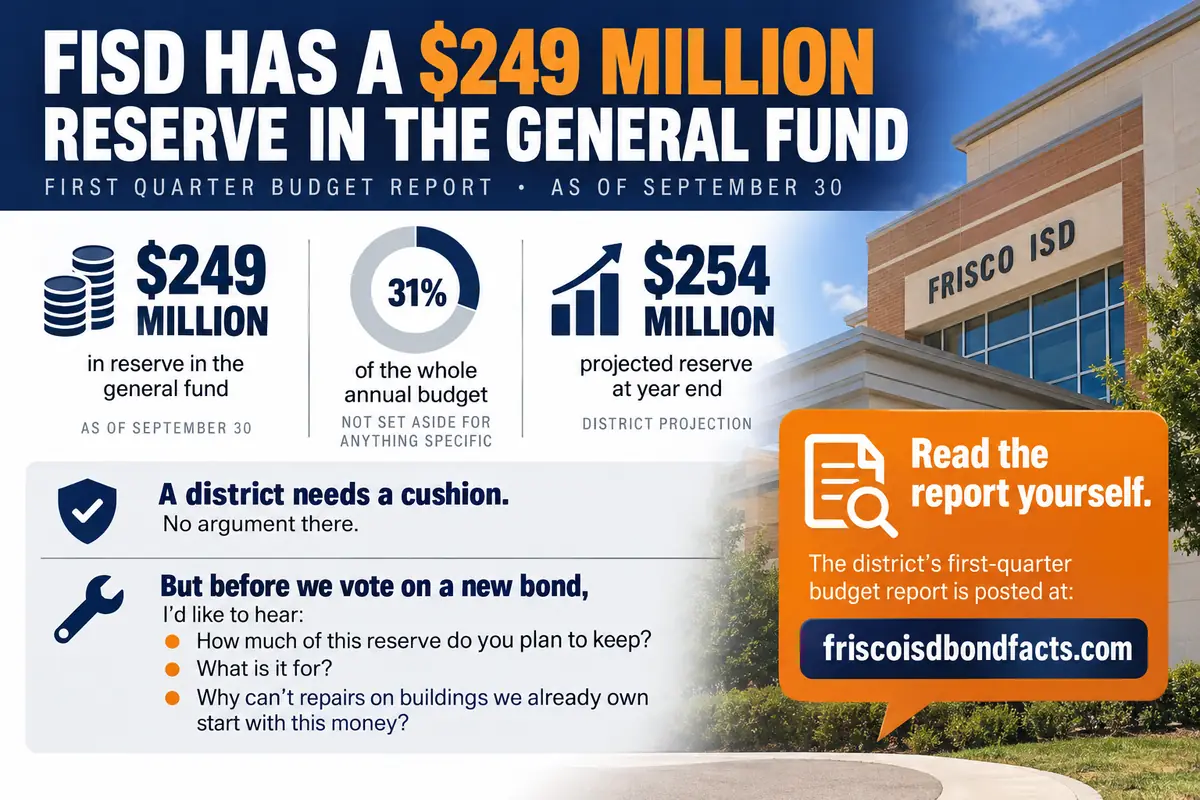
After two years of balanced budgets without the rejected tax increase, the reserve is still about a quarter of a billion dollars.
| General fund, FY2027 | Amount |
|---|---|
| Beginning fund balance (unaudited) | $280.6M |
| Revenue received, July to September | $51.3M |
| Spent, July to September | ($82.7M) |
| Fund balance, September 30, 2026 | $249.2M |
| Projected unassigned balance, end of year | $253.7M |
The same report confirms $44.9 million budgeted to flow from the general fund into the City's Tax Increment Fund this year, matching the TIRZ collections and state TIRZ aid the District counts as revenue.
Reserves are not a slush fund, and a district this size needs a cushion. But a quarter-billion-dollar reserve changes the bond conversation. Before voters are asked to borrow more, the District should explain how much of that reserve it plans to keep, what it is for, and why repairs on buildings it already owns cannot start there.
Figures are the District's unaudited first-quarter snapshot and will be updated after the 2025-26 annual financial report is final. Sources: Frisco ISD FY2027 Q1 Budget Update and 2026-27 General Fund budget amendment, Period 3, both posted for the October 19, 2026 board meeting.
Pool revenue the general fund doesn't show
The District's natatorium took in about $1.07 million in 2025-26, up 26% in two years, according to deposit ledgers released to us through a public information request. About 81% came from one outside swim club, Iron Horse Aquatics, whose payments grew from $714,649 to $871,010. Those payments and swim meet fees are deposited in the District's Athletic Fund (fund 164), not the general fund. Learn to Swim fees go to the general fund.
| Fiscal year | Iron Horse Aquatics | Swim meet fees | Learn to Swim | Total |
|---|---|---|---|---|
| 2023-24 | $714,649 | $23,782 | $113,010 | $851,570 |
| 2024-25 | $775,440 | $69,277 | $120,655 | $966,378 |
| 2025-26 | $871,010 | $87,954 | $112,823 | $1,072,584 |
| 2026-27, through Oct. 7 | $221,578 | $2,425 | $24,910 | $248,913 |
Net deposits, including refunds and adjustments. Totals include small amounts from online store sales and reimbursements. Category totals are our tally of the District's line items.
Revenue alone doesn't show whether the pool pays for itself. The District's capital plan shows the 2018 bond spent $26.2 million on the swim practice facility. The District should publish the natatorium's operating costs next to these deposits, along with the rates it charges outside clubs, so taxpayers can see whether pool rentals cover the cost of running the pool.
Source: Frisco ISD natatorium deposit ledgers, fiscal years 2024 through 2027 to date, Athletic Fund (fund 164, account 5752) and General Fund (account 5749), released under public information request W006257, October 2026.
What the District's new capital plan and tax calculator show
In October 2026 the District posted a Capital Projects table, current through September 30, and a Tax Calculator. Both are worth reading, and both leave questions open.
| From the District's capital plan | Budgeted | Spent or committed | Not yet spent |
|---|---|---|---|
| 2018 bond, all projects | $676.8M | $643.9M | $32.8M |
| incl. Staley Middle School 25-year refresh, "On Hold" | $20.0M | $0 | $20.0M |
| 2024 "interim" program, funded after the 2024 bond failed | $93.0M | $36.7M | $56.3M |
Category totals are our sum of the District's project rows.
The table's note says that after the 2024 bond failed, the District "reprioritized existing, available funds" to cover projects from the failed bond, "without additional borrowing." Asked on Facebook what paid for these projects, the District answered that every project in the table is "paid for with bond or TIRZ funds." It has not said how much of the $93 million came from TIRZ money, how much TIRZ money remains, or how much more is coming.
The Tax Calculator splits your Frisco ISD tax bill by fixed percentages. More than a quarter, 26.5%, already goes to bond repayment, before any new bond. The calculator has no slice for TIRZ, even though the District's own first-quarter report budgets $44.9 million this year to flow to the City's Tax Increment Fund.
If TIRZ money can pay for capital projects, voters deserve to know how much is available before they are asked to borrow. Unspent money already approved should be counted first.
Sources: Frisco ISD Current Capital Plan, "2018 Bond and 2024 Interim Programs," spending as of September 2026; Frisco ISD Tax Calculator (fisd-tax-calculator.js, Bond Repayment share 26.49%); Frisco ISD reply on its Facebook post about these tools, October 2026; Frisco ISD FY2027 Q1 Budget Update (TIRZ, $44.9 million).
Disclosure question: Lone Star Furnishings
Frisco ISD paid Lone Star Furnishings LLC about $50.4 million from FY2014 through FY2026, 96% of it from bond-funded capital projects, peaking at $11.1 million in FY2023.
New, November 17: the District paid Lone Star $15,517 from April through August 6, 2026, after Dr. Fouche became superintendent and before his disclosure was posted. See the payments
Payments peaked at $11.1 million in FY2023 and stayed high through FY2024, then fell sharply as 2018 bond money ran low.
| Fiscal year | General Fund | Capital Projects (bonds) | Total |
|---|---|---|---|
| FY2014 to FY2020 | $1.25M | $13.15M | $14.40M |
| FY2021 | $0.12M | $5.09M | $5.21M |
| FY2022 | $0.20M | $8.56M | $8.76M |
| FY2023 | $0.13M | $10.95M | $11.08M |
| FY2024 | $0.01M | $8.10M | $8.11M |
| FY2025 | $0.12M | $0.23M | $0.34M |
| FY2026 | $0.03M | $2.49M | $2.53M |
| Total | $1.86M | $48.56M | $50.42M |
The four highest years, FY2021 through FY2024, account for about $33 million, roughly two-thirds of the bond-funded total, during a span when the District opened only three campuses and was winding down construction. That spending tracks the 2018 bond's districtwide furniture and equipment refresh, not new schools.
How does one vendor collect this much without a contract ever reaching a board agenda? Through a purchasing cooperative. Frisco ISD has belonged to the TIPS cooperative (Texas Interlocal Purchasing System) since 2003, under an agreement that renews automatically until either side ends it. Buying through a cooperative is legal and common, and it lets districts skip separate bids. The tradeoff is visibility: years of vendor spending can run on autopilot with little public review. That is an argument for more transparency, not less, which is why the questions here still stand.
Texas law (Local Government Code chapter 176) requires a superintendent, and any District agent who helps plan, recommend, select, or contract with vendors, to disclose when a family member earns income from a District vendor. Public profiles indicate the superintendent's spouse has worked for this vendor since 2022. The vendor's own website says she joined that year and previously served as Frisco ISD's Chief Technology Officer. The District paid the vendor $19.2 million in FY2023 and FY2024 alone. Dr. Todd Fouche became superintendent in April 2026; during those years he was the District's deputy superintendent. As of October 8, 2026, the District's posted conflict of interest disclosures included no filing from the vendor or any District officer.
Update, October 17, 2026: After we asked the superintendent on October 11, Lone Star Furnishings signed a Conflict of Interest Questionnaire (Form CIQ) on October 15 naming Dr. Fouche and stating that his spouse is the vendor's VP of Sales and receives taxable income from it. The District posted the form on October 16. The superintendent's own conflicts disclosure statement, a separate filing the law requires of the officer, was posted on October 20 (see below). On October 15 the District told us the relationship had been disclosed internally to its procurement department and external auditors, that Mrs. Fouche's employment bars her from involvement in District business, and that Dr. Fouche does not take part in purchasing decisions involving this vendor. The District says it is reviewing the filing requirements, and we have asked when that review will be complete.
Update, October 20, 2026: both disclosures are now public. The District posted Dr. Fouche's Local Government Officer Conflicts Disclosure Statement (Form CIS), signed April 30, 2026, on the Office of the Superintendent page. It had been submitted to the District's business office but was not posted online, as Section 176.009 requires, until now. In writing, the Deputy Superintendent of Business and Operations told us the District recognizes that "transparency and public access to required disclosures are equally important, and we apologize for that oversight."
On the form, Dr. Fouche wrote, "None of her income comes from FISD." That is not the question the law asks. Section 176.003 asks whether the officer's family receives taxable income from a vendor the District does business with, and the vendor's own questionnaire answers yes. Her paycheck is not written by Frisco ISD, but it is written by a company Frisco ISD has paid $50.4 million since fiscal year 2014, including $2.5 million in fiscal year 2026.
Update, October 26, 2026: BuyBoard purchase records. In response to our public information request, BuyBoard, the purchasing cooperative run by the Texas Association of School Boards, reported that Frisco ISD placed 175 orders with Lone Star Furnishings under a single contract, No. 584-19, totaling $14.1 million between June 2019 and February 11, 2022. No BuyBoard orders followed. Two orders entered February 14, 2022 were cancelled with the reason "Not BuyBoard Contract per Customer."
The District's check registers show its largest payments to Lone Star came after that: $11.1 million in fiscal year 2023 and $8.1 million in fiscal year 2024. BuyBoard says 584-19 was the only contract it awarded Lone Star during the period, so the shift may simply reflect that contract ending. The open question is which purchasing contract the District used for its Lone Star purchases after February 2022. Asked directly, the District's deputy superintendent for business and operations replied on November 11 that the question should go through the public information request process.
Our view: disclosure is the floor, not the fix. As long as the superintendent's spouse is a sales executive at this vendor, the District should take new furniture purchases elsewhere. The furniture is made by manufacturers, not by this dealer. Smith System, one of the lines Lone Star sells, holds a statewide BuyBoard contract that lets Texas districts order directly from the manufacturer.
Before voters approve new bond money, much of which has historically gone to furniture, the District should confirm every required disclosure is on file.
Payments since Dr. Fouche became superintendent
Dr. Fouche's first board meeting as superintendent was April 13, 2026. His official start date is not verified, and his conflicts disclosure statement is signed April 30, 2026. From April through August 6, 2026, the last date in the District's posted FY2026 check register, the District paid Lone Star Furnishings three times, $15,517 in total.
| Check date | Amount | Paid from |
|---|---|---|
| April 14, 2026 | $3,979.00 | General fund ("Quote 20385") |
| May 19, 2026 | $1,560.80 | 2018 bond construction fund (chair, Smith System upgrade, shipping, installation) |
| June 23, 2026 | $9,977.66 | 2018 bond construction fund (furniture, shipping, installation) |
| Total, April 1 to August 6, 2026 | $15,517.46 |
For comparison, earlier in the same fiscal year, July 2025 through March 2026, the District paid Lone Star $2.51 million, most of it a $2.1 million "2025 Refresh" payment in August 2025.
What these figures do not show:
- Payments after August 6, 2026. The 2026-27 check register is not posted yet. No Lone Star purchase appears on the District's October 2026 list of purchases over $100,000.
- Orders versus payments. These are the dates checks were cut. An order paid in April may have been placed earlier, and an order placed this summer may not be paid yet. We have asked the District for its Lone Star contracts and orders since 2022 and will post what it releases.
The amounts since April are small, mostly add-on items, shipping and installation. The larger issue is timing. On June 8, 2026, with Dr. Fouche present, the Board approved its fiscal year 2027 internal audit plan 7 to 0 without discussion. That plan includes a purchasing audit that will review bids, Board approvals and "conflict of interest forms and required postings." The superintendent's own disclosure statement, signed April 30, was not posted until October 20, nearly six months later. We will ask the Board to make sure the purchasing audit covers it.
Lone Star Furnishings also gave $5,000 on October 16, 2024 to Vote for Frisco ISD, the political committee that campaigned for the 2024 bond. That was about 2% of the $234,428 the committee raised; the committee itself paid for the mailers, signs and texts. When the company made that contribution, the superintendent's spouse already worked there (the vendor's website says she joined in 2022), and Dr. Fouche was the District's deputy superintendent. Who paid for the 2024 bond campaign
Sources: Frisco ISD FY2026 check register, General Fund and Capital Projects tabs, vendor Lone Star Furnishings LLC, through August 6, 2026; Frisco ISD purchases over $100,000, October 2026 (November 16, 2026 board packet); Frisco ISD Board of Trustees meeting video and caption transcript, June 8, 2026, item 13.B (FY2027 internal audit plan); Todd Fouche Form CIS signed April 30, 2026, posted October 20, 2026.
Trustee replies: 3 of 7 as of November 13. On October 20, 2026, we emailed all seven trustees asking the board to end new purchases from Lone Star Furnishings while the superintendent's spouse works there. No trustee replied until we followed up on November 10. On November 11, Trustee Suresh Manduva replied that the earlier email had been missed among other messages and that he would research the findings. On November 13, Trustee Misty Wamhoff replied, referring us to the Board Policy Manual on purchasing, transparency and conflicts of interest, saying the Board takes these issues seriously and works with Administration on compliance, and noting that Board personnel discussions are confidential by law. On November 13, Trustee Keith Maddox replied, also referring us to the Board Policy Manual, saying the Board takes parent concerns seriously and will address topics that need Board consideration, and noting that some subjects cannot be discussed publicly and that a lack of response does not necessarily mean a matter has not been or will not be addressed. Trustees Davis, Elad, Salas and Sample have not replied. We will post any response we receive. Read every email we sent
Sources: Frisco ISD check registers, FY2014 to FY2026, General Fund and Capital Projects tabs, vendor 16611 (line items only); Frisco ISD Disclosures / Conflict of Interest page, reviewed October 8 and October 17, 2026; Lone Star Furnishings Form CIQ signed October 15, 2026, as posted by the District; Todd Fouche Form CIS signed April 30, 2026, as posted by the District October 20, 2026 (date of birth redacted in our copy); BuyBoard (Local Government Purchasing Cooperative, Texas Association of School Boards) response to our public information request, October 26, 2026, with purchase order history and sales and service fee report for Lone Star Furnishings and Frisco ISD, January 1, 2019 to October 12, 2026; Lone Star Furnishings staff profile, reviewed October 10, 2026; Frisco ISD superintendent announcement (April 2026); Texas Local Government Code chapter 176, including section 176.001(4).
Who paid for the 2024 bond campaign
The political committee that campaigned for the 2024 bond, Vote for Frisco ISD, reported raising $234,428 and spending $248,445. About 95% of the money came from businesses, $223,833, many of them the firms that build, design, and furnish Frisco ISD schools. Individuals gave about $10,600 in total.
Nine companies that build or supply Frisco ISD schools gave the PAC $51,000 combined.
| District contractor or vendor | Gave to the PAC | Paid by Frisco ISD |
|---|---|---|
| CORE Construction | $5,000 | about $306M |
| Joeris General Contractors (three entries) | $7,500 | about $120M |
| Crossland Construction | $5,000 | about $53M |
| Lone Star Furnishings | $5,000 | about $35M |
| Corgan Associates (architect) | $5,000 | about $20M |
| Hellas Construction | $5,000 | about $14M |
| Progressive Services | $5,000 | about $7.5M |
| Armko Industries | $5,000 | about $4.3M |
| One Source (three companies) | $8,500 | about $4.2M |
Other large donors included EMA Engineering ($20,000) and, at $10,000 each, Century Mechanical, Foodservice Design Professionals, Piper Weatherford, RLK Engineering, and FC Dallas. The committee is still active, with $27,087 on hand as of its latest report.
None of this is illegal, and it's common in Texas. But voters should know that much of the money urging a yes vote came from companies that would be paid with bond money. Before the 2027 vote, ask who's paying for the campaign.
About three quarters of the money went to mailers, signs, and text messages.
| Where the money went | What for | Amount |
|---|---|---|
| ProPublic Education (Fort Worth) | Mailers, printing, postage, yard and road signs, website | about $121,600 |
| KC Strategies (Austin) | Texting and digital marketing | $64,317 |
| Baselice & Associates (Austin) | Community survey (polling) | $26,638 |
| Phone bank contractor | Calling service | $25,000 |
| CDC Communications (Frisco) | Poll workers | $8,782 |
| All other | Signs, T-shirts, event food | about $2,100 |
Lone Star Furnishings has backed school bond campaigns across North Texas
Texas Ethics Commission records show Lone Star Furnishings, the District's furniture vendor, gave $21,500 to ten school bond campaigns from 2018 to 2026. That includes both recent Frisco ISD bond campaigns: $500 for the 2018 bond, which passed, and $5,000 for the 2024 bond, its largest gift on record. After the 2018 bond passed, Frisco ISD paid Lone Star $11.1 million in FY2023 and $8.1 million in FY2024, much of it from bond funds.
| Date | Committee | Election | Amount |
|---|---|---|---|
| Oct 25, 2018 | Frisco Residents for Public Education PAC | Frisco ISD 2018 bond and tax election | $500 |
| Oct 1, 2019 | Vote YES Forney ISD | Forney ISD bond | $500 |
| Oct 15, 2019 | For All Kids | Arlington ISD bond | $500 |
| Sep 28, 2021 | Vote Yes Rockwall ISD | Rockwall ISD | $500 |
| Oct 4, 2022 | Friends of Terrell ISD | Terrell ISD | $1,000 |
| Oct 16, 2024 | Vote for Frisco ISD | Frisco ISD 2024 bond | $5,000 |
| Oct 17, 2024 | Vote For Rockwall ISD | Rockwall ISD | $5,000 |
| Apr 21, 2025 | Classrooms for Cardinals | Melissa ISD | $3,000 |
| Apr 29, 2025 | Vote Yes Mesquite ISD PAC | Mesquite ISD | $3,000 |
| Jun 4, 2026 | Dallas Votes 4 Kids PAC | Dallas ISD | $2,500 |
| Total | $21,500 | ||
Contributions made by the company, as reported by each committee. Rockwall, Terrell and Dallas elections are identified by committee name. A 2021 Rockwall contribution reported twice is counted once. Personal donations by employees are not included. Committees that filed only with a local filing authority would not appear in this data.
Giving to bond campaigns in districts that buy from you is common and legal for a vendor. In Frisco's case, the vendor's sales VP is the superintendent's spouse, who joined the company in 2022. Before the 2027 vote, watch whether Lone Star gives again. Lone Star payments since April 2026
Download every business contribution (CSV). Contributions from individuals are not listed here; they are public at the Texas Ethics Commission.
Sources: Vote for Frisco ISD (Texas Ethics Commission filer 00088929) reports as filed: 30th day before election (filed October 7, 2024), 8th day before election (October 28, 2024), and January 15, 2025 semiannual. Lone Star contributions to other committees: Texas Ethics Commission campaign finance database (TEC_CF_CSV), downloaded November 17, 2026, contributor "Lone Star Furnishings"; committee purposes from each committee's filings. Payments by Frisco ISD are FY2019 to FY2026 totals from the District's check registers, matched by company name, and are approximate.
Fewer students, more debt
The District's operating budget has been held nearly flat, but bond payments keep climbing while the number of students shrinks. Each remaining student now carries more debt.
Debt per student is up 13% in three years.
| School year | Debt service | Cost per student |
|---|---|---|
| 2023-24 | $176.3M | $13,923 |
| 2024-25 | $179.3M | $14,424 |
| 2025-26 | $198.4M | $15,414 |
| 2026-27 | $201.2M | $15,789 |
| Change | up 14% | up 13% |
Sources: Frisco ISD adopted budgets, All Funds summary, 2023-24 through 2026-27. Enrollment: NCES Digest of Education Statistics, Table 215.30 (fall 2021), and state enrollment data via the Texas Tribune Schools Explorer (2026).
How the District serves its most vulnerable students
Each year the Texas Education Agency reviews how districts serve special education students, emergent bilingual students, and foster, homeless and military-connected students. Its Results Driven Accountability report scores each measure from 0, meeting the state standard, to 4. Frisco ISD's 2025 report rates the District "Meets Requirements" in all three areas. Underneath, special education results are slipping, and the District has been flagged for significant disproportionality three years running on five measures.
Start with income. About 14% of Frisco ISD students, roughly 8,800 children, are economically disadvantaged. The other 86% are not. TEA's 2025 performance report shows how far apart those two groups are.
Only 36% of Frisco ISD's low-income students meet grade level in math, barely above low-income students statewide and below the state average for all students.
| STAAR 2025, meets grade level or above | All subjects | Math | Reading |
|---|---|---|---|
| Frisco ISD, all students | 77% | 72% | 81% |
| Frisco ISD, economically disadvantaged | 45% | 36% | 52% |
| Texas, economically disadvantaged | 39% | 34% | 43% |
| Texas, all students | 50% | 45% | 54% |
| Frisco ISD, special education | 39% | 36% | 41% |
| Texas, special education | 23% | 23% | 23% |
All grades tested. The 8,800 figure is our calculation: 14.1% of 62,627 students.
Frisco ISD's low-income students outperform their statewide peers in reading by 9 points. In math the gap is 2 points. Inside the District, they trail their classmates by 32 points overall and 36 in math. The A rating reflects the advantages most Frisco families bring. The harder question is what the District does for the students who don't have them.
Special education math pass rates have fallen three years in a row, while the number of special education students tested rose 18%.
| Special education, STAAR passing rate | 2023 | 2024 | 2025 | State standard |
|---|---|---|---|---|
| Math, grades 3-8 | 65.4% | 61.9% | 59.5% | 70% |
| Reading, grades 3-8 | 70.2% | 68.0% | 68.7% | 70% |
| Social studies, grade 8 | 55.0% | 65% | ||
| Algebra I | 64.3% | 65% | ||
| English I and II | 58.2% | 60% |
Special education graduation rate, 2025: 81.4%, compared with 95.2% for the District overall. Students in the year after they exit special education passed math at 93.5%.
TEA flags "significant disproportionality" when one group of students is at least 2.5 times as likely as all others to be identified, placed or disciplined a certain way. Frisco ISD is in its third consecutive year on five measures:
| Finding, 2025 | Group | All others | Ratio |
|---|---|---|---|
| Asian special education students identified with autism | 48.9% | 18.5% | 2.6 |
| Asian special education students in regular classes less than 40% of the day | 27.0% | 10.4% | 2.6 |
| African American special education students, out-of-school suspension | 8.8% | 2.8% | 3.1 |
| African American special education students, in-school suspension | 11.6% | 4.4% | 2.7 |
| African American special education students, total disciplinary removals | 35.1% | 11.8% | 3.0 |
Other measures below the state standard in 2025: 14.2% of special education students spend most of the day outside regular classes, against a target of 10% or less; emergent bilingual students passed English I and II at 54.8%, against a standard of 60%; and foster, homeless and military-connected students graduated at 66.7%, against a standard of 80%. In 2024, TEA rated the District "Needs Assistance" for that last group.
These findings are about District practices: how students are identified, placed, supported and disciplined. The District should report to the community what it is doing about each one. None of them is solved by a new building.
Sources: Texas Education Agency, Results Driven Accountability District Reports for Frisco ISD (county-district number 043905), 2023, 2024 and 2025; Texas Academic Performance Report, 2024-25 STAAR Performance, Frisco ISD and State. Performance levels, cut points, rates and significant disproportionality status are as reported by TEA; counts are masked by TEA where small.
What the District spends on career education
Frisco ISD spends $18.3 million a year on career and technical education, about $281 per student. The average Texas district spends $466 per student, 40% more. Frisco ISD spends slightly more on athletics than on career education, and career education spending dipped last year.
Career and technical education gets 2.5% of Frisco ISD's operating budget, below the state's 3.6%.
| Program, 2024-25, all funds | Frisco ISD | Share of operating budget | Per student | Texas per student |
|---|---|---|---|---|
| Career and technical education | $18.3M | 2.5% | $281 | $466 |
| Athletics | $18.6M | 2.6% | $285 | $263 |
| Gifted and talented | $8.9M | 1.2% | $137 | $70 |
| College, career and military readiness | $5.9M | 0.8% | $90 | $74 |
Career and technical education spending was $18.6 million in 2023-24 and $18.3 million in 2024-25. Advanced Placement, International Baccalaureate and dual credit are mostly paid for inside regular classroom spending, so there is no separate college-prep line to compare.
Trade jobs such as electricians, HVAC technicians, and solar and wind technicians are projected to grow faster than the economy, and many Frisco ISD graduates will build careers without a four-year degree. Career programs should be growing, not flat. That is a budget priority, not a bond question.
Source: Texas Education Agency, PEIMS District Financial Actual Reports, Frisco ISD (043905) and State, 2023-24 and 2024-25, operating expenditures by program intent code, all funds. Job growth: Bureau of Labor Statistics Employment Projections, 2025-35.
What Frisco's A rating looks like with achievement taken out
Frisco ISD earned a 91, an A, in the 2026 state accountability ratings, and the District often calls itself the largest A-rated district in Texas. An independent analysis by Texas Trustee Data, run by former Comal ISD trustee Stephen Smith, recalculated each district's score without the Student Achievement domain, which tracks closely with family income. On that basis Frisco scores 85, a B. Most districts drop six to eight points the same way, so Frisco is in the middle of the pack, not an outlier.
| District | 2026 TEA score | Without achievement | Economically disadvantaged |
|---|---|---|---|
| Highland Park ISD | 95 (A) | 89 | 0.7% |
| Lovejoy ISD | 94 (A) | 88 | 3.7% |
| Coppell ISD | 93 (A) | 86 | 9.1% |
| Argyle ISD | 92 (A) | 86 | 6.2% |
| Frisco ISD | 91 (A) | 85 | 14.1% |
| Rockwall ISD | 91 (A) | 85 | 27.2% |
| Prosper ISD | 91 (A) | 84 | 6.1% |
| Allen ISD | 90 (A) | 84 | 21.0% |
| Wylie ISD | 88 (B) | 81 | 21.9% |
| Celina ISD | 85 (B) | 78 | 16.2% |
TEA scores and economically disadvantaged rates are the state's 2026 figures. The "without achievement" column is Texas Trustee Data's own calculation. Its author, former Comal ISD trustee Stephen Smith, explains the method: remove the Student Achievement scores, which track family income, and calculate the grade the way TEA would from the remaining domains. It is not a TEA figure, and we have not independently recalculated it.
An A is worth celebrating, and teachers earned it. But a rating measures test results, not whether buildings need $1 billion. It is not a reason to approve a bond, and it should not be used as one.
Sources: Texas Education Agency, 2026 accountability ratings (rptsvr1.tea.texas.gov/perfreport/account); Texas Trustee Data, "2026 Accountability Ratings: Districts," facebook.com/TXTrusteeData, November 2026.
Where graduates go: the District tracks it, but withheld the reports
Frisco ISD pays the National Student Clearinghouse about $6,000 a year for StudentTracker for High Schools, a service that reports how many graduates of each high school enroll in college, return for a second year and finish a degree. Those are the outcome numbers that show whether the District's high schools are preparing students for what comes next.
On October 31 we asked for those reports, aggregate only, with any small cells redacted under FERPA (request W006325). On November 13 the District released the agreement and two purchase orders, but withheld every report. It cited an October 2025 Attorney General ruling that let it withhold reports for one school after the Clearinghouse argued they are proprietary commercial information.
| StudentTracker, what the records show | Detail |
|---|---|
| Agreement | Signed May 2, 2024 by the District's procurement director; renews until either side cancels |
| 2025-26 order | $5,940 for 12 high schools ($595 each, less $100 per school), sole source |
| 2026-27 order | $6,435 for 13 high schools, sole source |
| Who may see the reports | The board and school officials with a legitimate educational interest (agreement, paragraph 11) |
| Public use | Any District report or presentation that uses the data must credit the Clearinghouse (paragraph 21) |
| 2025 ruling | OR2025-036695 covered "specified reports related to a specified district school," which the District says was Reedy High School. The Attorney General also noted the District did not meet its deadline to request that ruling. |
We have asked the District to reopen the request. The 2025 ruling says it is "limited to the particular information at issue" and "must not be relied upon as a previous determination regarding any other information." Our request covers all high schools, district totals and reports issued after that ruling. Under the Attorney General's Open Records Decision No. 673, a prior ruling applies only to precisely the same records. For anything else, the District must release it or ask the Attorney General for a new ruling.
The District answered the same day. It said our request includes the 2025 Reedy High School report the Attorney General already reviewed, that the facts behind that ruling have not changed, and that it is not required to create a new record showing only aggregate data. It did not say that the reports for its other high schools or other graduating classes were ever submitted to the Attorney General.
Update, November 16, 2026: the District has now asked the Attorney General for a new ruling on all of the district and campus StudentTracker reports, citing sections 552.101, 552.110 and 552.228 and copyright. Its letter says our objection is what made the new request necessary. The Clearinghouse will be notified and may argue against release. Other districts already publish these reports: Dallas ISD posts its StudentTracker reports online. We will submit our own comments to the Attorney General and post the ruling when it comes.
Trustees can see these reports today under the District's own agreement. Before voters are asked for more money, the community should know how Frisco ISD graduates do after they leave.
Sources: Frisco ISD responses to public information request W006325, November 13, 2026, and the District's request for an Attorney General ruling, November 16, 2026, with the National Student Clearinghouse StudentTracker for High Schools agreement (signed May 2, 2024) and purchase orders for 2025-26 and 2026-27; Texas Attorney General letter ruling OR2025-036695, October 10, 2025; Open Records Decision No. 673 (2001).
Repairs belong in the budget
Routine upkeep should come from the operating budget, not decades of debt. Frisco ISD cut its maintenance budget for 2026-27 and sets aside almost nothing for capital repairs from operations. That leaves bonds as the default for roofs, air conditioning, and building systems.
Source: Frisco ISD 2026-27 adopted budget, General Fund summary.
Seen a repair they haven't made?
The District wants a new bond while buildings it already owns wait on basic upkeep. If you have seen a repair that is overdue, a leak, a broken system, a safety issue, send it in and I will look into it. Include the campus or location, the date you saw it, a short description, and a photo if you have one.
Nothing is posted automatically. I review every submission, confirm it, keep names out of it, and remove students' faces before anything goes on this page.
How Frisco compares
Frisco ISD has held its debt rate at exactly 27 cents per $100 since 2018. Districts its size show that rate can come down. Fort Worth ISD cut its debt rate from 27.55 cents to 24.22 cents for 2025-26.
| District | Students (fall 2021) | 2025-26 total rate | Debt (I&S) rate |
|---|---|---|---|
| Frisco ISD | 65,825 | $1.0194 | $0.2700 |
| Conroe ISD | 67,761 | $0.9496 | $0.2800 |
| Aldine ISD | 61,633 | $1.0340 | $0.3025 |
| North East ISD | 59,830 | $0.9822 | $0.3000 |
| Fort Worth ISD | 74,850 | $1.0291 | $0.2422 |
| Klein ISD | 53,294 | $1.0119 | $0.3150 |
| Fort Bend ISD | 77,545 | $1.0569 | $0.2700 |
A flat rate is not a flat bill. Frisco ISD reports the average home value rose from $551,246 to $565,084 for 2026, so the unchanged rate raised that homeowner's school tax bill by $141.
Sources: NCES Table 215.30 (enrollment); Texas Comptroller, 2025 School District Tax Rates and Levies (tax year 2025, the 2025-26 school year); Fort Worth ISD adopted tax rate history; Frisco ISD 2026 tax rate announcement. Fort Bend's rate includes a temporary 7 cent disaster increase.
Who is writing the bond
The 2027 Bond Committee has 100 members. Only 25 seats were open to residents who applied, and 99 people applied for them. The Board and District leadership chose 80 of the 100 members, including 20 District employees.
| Chosen by | Seats |
|---|---|
| Board of Trustees, 5 each | 35 |
| District leadership, from resident applications | 25 |
| District leadership, District staff | 20 |
| High school students, approved by principals | 12 |
| PTA council, Frisco Education Foundation, Frisco Chamber | 8 |
Source: Frisco ISD Deputy Superintendent of Business and Operations, written response to a resident inquiry, October 6, 2026.
What trustees were told before the committee met
On September 10, 2026, four days before committee applications opened, the Deputy Superintendent of Business and Operations emailed trustees a "Bond Planning Updates" memo. We obtained it through a public information request. It asked each trustee to start identifying five appointees and to "personally encourage them to complete the application," and to help amplify the District's bond posts from their trustee social media accounts.
It also gave trustees talking points. They could say the District has "real capital needs that can only be addressed with a bond program," and that "there is no predetermined bond package or amount." On the list of things not to say yet: a bond amount or range, or any promised tax impact.
Before the committee met once, trustees were told to say the District's needs "can only be addressed with a bond program." That is the conclusion the committee is supposed to reach on its own.
The memo tells trustees to attend committee meetings "as observers rather than participants," since the Board will vote on the recommendation. That is the right instinct, but it sits uneasily with trustees choosing 35 of the 100 members and receiving talking points before the first meeting.
The memo also says the polling firm Baselice would survey the community this fall to inform both the committee's work and the District's communications plans. Frisco ISD paid Baselice $29,364 for a survey in October 2024, ahead of the last bond election. That same fall, the pro-bond PAC paid Baselice $26,638 for its own community survey (see who paid for the 2024 bond campaign).
The memo promises regular updates like this through the fall, archived for trustees. They should be posted for the public too.
Sources: Frisco ISD "Bond Planning Updates" email from the Deputy Superintendent of Business and Operations to trustees, September 10, 2026, released under public information request W006257; Frisco ISD check register, FY2025, Baselice and Associates, $29,364, October 23, 2024, general fund, "survey"; Vote for Frisco ISD campaign finance reports (Baselice and Associates, $26,638).
Who it is built for
This committee will help shape schools for a student body that looks very different than it did a decade ago. Frisco ISD is now about three in four students of color, with no single group a majority.
| Frisco ISD students | 2016 | 2026 |
|---|---|---|
| Asian | 20.9% | 44.9% |
| White | 51.0% | 25.9% |
| Hispanic | 13.8% | 12.6% |
| Black | 10.4% | 10.5% |
Share of enrollment. A decade ago the district was majority White; today White students are about a quarter. Source: TEA PEIMS enrollment.
The District says it chose committee members on zip code, tenure, civic involvement, prior bond committee experience, and availability. None of those aims at reflecting the families the bond affects. So the group deciding whether to recommend a new bond is nearly half District employees and leadership, picked with no eye to the community it will tax.
This is not about any member, it is about design. A bond review built for institutional familiarity instead of independence is exactly what a trustee should fix: a committee that is majority independent and reflects the community it serves.
One question for the District
Before anyone votes, Frisco ISD should publish the projected Interest and Sinking tax rate, year by year, two ways:
- Without the 2027 bond
- With the 2027 bond
If the first line falls after 2034 and the second stays flat, the bond costs taxpayers real money compared to letting old debt pay off. Voters deserve to see both lines side by side.
Update, November 10, 2026: the District's own model now shows the second line, peaking at 36 cents in FY2033 for just the first five years. It still has not published the first. See the numbers
Get involved
This effort started with one Frisco resident reading the District's own documents. If these numbers concern you, here are three things you can do in under a minute.
1. Get updates
One email when new District documents or bond numbers are posted. Nothing else, and we never sell your address. We'll email you a link to confirm. Privacy
2. Ask the Board
Opens a short, polite email to all seven trustees asking for the debt tax rate with and without the bond, monthly capital plan updates, and useful life next to debt length. Edit it however you like.
Email the BoardTrustee addresses are from the District's Meet the Board page.
3. Share this page
Most people never see the District's documents. Send this to one neighbor, or share any number on this page with its own link.
Board meetings and public comment: Frisco ISD Board of Trustees.
Download the data
Get the full spreadsheet: Frisco ISD and 15 comparison districts, 2015-16 to 2025-26, with 24 measures covering enrollment, demographics, staffing, superintendent and teacher pay, and actual spending by category. Each sheet includes the peer median, the regional median, and Frisco's rank, calculated with live formulas so you can check or change anything.
All figures come from Texas Education Agency public files. Dollar figures marked 2026 $ are adjusted for inflation.
Sources
Check every figure yourself.
- Frisco Independent School District, Unlimited Tax Refunding Bonds, Series 2026, Official Statement dated April 15, 2026, Appendix A. Available free on the MSRB's EMMA system, emma.msrb.org.
- Frisco ISD Adopted Budget, raw format files, fiscal years 2023-24, 2024-25, 2025-26, and 2026-27, All Funds and General Fund summaries.
- Frisco ISD written response on 2027 Bond Committee appointments, October 6, 2026.
- National Center for Education Statistics, Digest of Education Statistics 2022, Table 215.30, enrollment of the 120 largest school districts, fall 2021.
- Texas Education Agency, PEIMS Standard Reports: Staff Salaries and FTE Counts and Student Enrollment, 2015-16 to 2025-26; PEIMS Actual Financial Data, FY2016 to FY2024.
- Adopted 2025-26 tax rates for Frisco, Conroe, Aldine, North East, Fort Worth, Klein, and Fort Bend ISDs, as published by each district or by Community Impact.